
How to Sell a House in Probate in Texas
A house can be sold during probate. What changes is who signs, and what the title company needs to see before they will insure it.

A house can be sold while the estate is still in probate. People assume otherwise and wait, sometimes for a year, for something that was never required. What actually changes is who has authority to sign the deed, and how much the court has to be involved in approving the price.
Who has the authority to sell?
Whoever the court has appointed, and nobody else. An executor named in a will has no authority until letters testamentary are issued. Where there is no will, the court appoints an administrator and issues letters of administration. That document is what the title company will ask for, and it is what gives the signature on the deed legal effect.
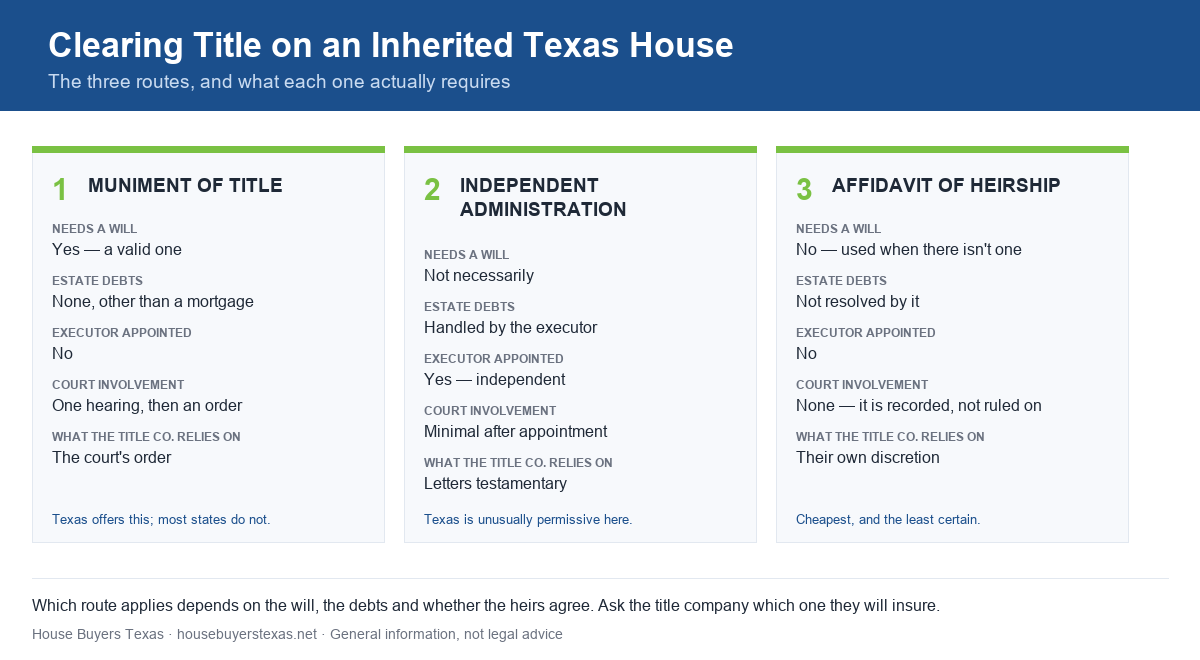
Heirs who have not been appointed cannot sell the property even if everyone agrees they should. This is the point at which most probate sales stall.
Does the court have to approve the price?
It depends on which kind of administration the estate is under, and in Texas the difference is large.
Under an independent administration, the executor can generally sell estate property without seeking court approval of the sale or the price. Texas allows this far more readily than most states, and it is the main reason probate here is less painful than its reputation suggests.
Under a dependent administration, the administrator must apply to the court for permission to sell, and the court confirms the terms. That adds hearings and time. Dependent administration usually arises where the estate is contested or the will did not provide for independence.
What does the title company actually require?
Ask them early, because they are the gatekeeper and their list is specific. Expect them to want the letters testamentary or of administration, the order admitting the will if there was one, the death certificate, and confirmation that the creditor notice period has run or that debts are otherwise handled.
Where a dependent administration applies, they will want the court's order approving the sale. Getting that list at the start rather than a week before closing is the single most useful thing you can do to keep the timeline honest.
What about the four-year deadline?
Texas generally requires a will to be admitted to probate within four years of the date of death. Miss it and the will typically cannot be probated in the ordinary way, and the estate passes as if there had been no will at all — which may distribute the house very differently from what the deceased intended.
Families discover this when they finally try to sell a house that has sat since a parent died. If you are anywhere near that window, that fact alone should set your timeline.
Why do probate sales fall through?
Most often because the buyer's financing runs out of patience. A retail buyer with a mortgage has a rate lock and a lender with its own timetable, and a probate sale has steps that are outside the seller's control. When a hearing gets continued or a title requirement surfaces late, the lock expires and the buyer walks.
Cash buyers do not have that constraint, which is why estates often prefer them despite a lower headline price. There is no lender, no appraisal contingency, and the closing date can move without the deal dying.
Does the house need repairs to sell in probate?
No, and pushing repairs through an estate is awkward. Estate funds are supervised, heirs often disagree about spending on a house they are about to sell, and the executor takes on personal exposure for decisions that later look poor. Selling in its current condition avoids that entire argument.
A practical order of operations
Get appointed first. Get the title company's requirement list second. Establish whether the administration is independent or dependent, because that determines whether the court prices the sale. Only then start talking to buyers.
We buy probate properties throughout Texas, including sell my house fast in Dallas, and we are used to closing around a court calendar rather than fighting it. If you want to see how the numbers work before you are appointed, our inherited property page walks through it.
House Buyers Texas buys houses; we are not attorneys and this is not legal or tax advice. Texas probate turns on facts specific to your situation, and a probate attorney or CPA is worth the consultation before you commit to a route.